Compare Two Independent Samples
The command compares two independent samples using the Mann-Whitney U test (nonparametric alternative to the t-test for independent samples), Kolmogorov-Smirnov test, Wald-Wolfowitz Runs test and Rosenbaum Q criterion.
How To
Run: Statistics→Nonparametric Statistics → Compare Two Independent Samples...
Select two variables to compare.
Results
Mann-Whitney U Test is a nonparametric counterpart to the t-test, it is also known as Mann–Whitney–Wilcoxon (MWW) or Wilcoxon rank-sum test. The test assumes that the variables are measured on at least an ordinal scale (rank order).
The test statistics is the smallest of the two U values, defined as:
 (no
ties),
(no
ties),
where  is
the size and the
is
the size and the  is
the sum of the ranks for the ith sample.
is
the sum of the ranks for the ith sample.
For small samples the significance level is calculated using the Dineen and Blakesley (1973) algorithm. If the final p-value ≤ 0.05 the decision is to reject the null hypothesis. Null hypothesis for Mann-Whitney U is that there is no difference between the ranks of the two samples
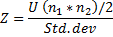
Z, approximately distributed as a standard normal, is defined as:
Provided p-value is two-tailed.
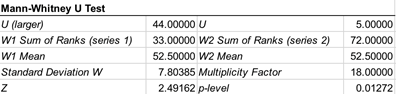
Kolmogorov-Smirnov test is a two-sample test of the null hypothesis that x and y were drawn from the same continuous distribution is performed.
Wald-Wolfowitz Runs test is another alternative of t-test that detects two independent samples from different populations with different cumulative distribution functions. The assumption for the test –samples are mutually independent are there are no, or few, ties between samples. The test can detect differences in averages or spread or any other important aspect between the two populations. It is efficient when each sample size is moderately large.
Null hypothesis H0 is that there is no statistically significant difference between the two continuous cumulative distribution functions
If Runs Count R ≤ Rc we reject H0.
References
Black, K. (1994). Business statistics: Contemporary decision making. Minneapolis: West Pub. Chicago.
Dineen, L. C., and B. C. Blakesley. 1973. Algorithm AS 62: Generator for the sampling distribution of the Mann-Whitney U statistic. Applied Statistics, 22, 269-273.
Daniel, Wayne W. (1990). "Kolmogorov–Smirnov one-sample test". Applied Nonparametric Statistics (2nd ed.). Boston: PWS-Kent. pp. 319–330.