Adaptive/Group Sequential Designs for Clinical Trials - This course will teach you how to design, monitor and analyze clinical trials using statistically sound principles that incorporate interim looks at the data, possible early stopping, and interim re-estimation of power and required sample size. It covers group sequential designs and adaptive methods of sample-size re-estimation.
Advanced Design of Experiments - The aim of the course is to present advanced and important concepts that have received very little attention, such as designs for irregular experimental regions and Analysis of Means (ANOM).
Advanced Resampling Methods - The course extends the range of application of decision-free procedures including the bootstrap, decision trees and permutation (randomization) tests. All sessions include critical appraisal methodology and exercises. Participants will learn to analyze experimental designs, create their own statistics, analyze categorical data as well as combinations of categorical and continuous data, and develop and validate models.
Basic Concepts in Probability and Statistics -
This course provides an easy introduction to statistics and statistical terminology through a series of practical applications. Once you've completed this course you'll be able to summarize data and interpret reports and newspaper accounts that use statistics and probability. You'll use simulation and resampling to fully grasp the difficult concept of "statistical significance."
Introduction to Bayesian Statistics -
This course will introduce you to the basic ideas of Bayesian Statistics. You will learn how to perform Bayesian analysis for a binomial proportion, a normal mean, the difference between normal means, the difference between proportions, and for a simple linear regression model.
Introduction to Biostatistics - This course covers the principal statistical concepts used in biostatistics. Basic concepts common to all statistical analysis are reviewed, and those concepts with specific importance in biostatistical are covered in detail.
Categorical Data Analysis - This course will cover the analysis of contingency table data (tabular data in which the cell entries represent counts of subjects or items falling into certain categories). Topics include tests for independence (comparing proportions as well as chi-square), exact methods, and treatment of ordered data. Both 2-way and 3-way tables are covered.
Clinical Trial Design - This course covers the essential concepts required to design rigorous randomized trials so as to ensure valid treatment comparisons.
Cluster Anaylsis - This course will teach you how to use various cluster analysis methods to identify possible clusters in multivariate data. Methods discussed include hierarchical clustering, k-means clustering, two-step clustering, and normal mixture models for continuous variables.
Introduction to Data Mining -
This course covers the two core paradigms that account for most business applications of data mining: classification and prediction. In both cases, data mining takes data where a variable of interest is known and develops a model that relates this variable to a series of predictor variables. In classification, the variable of interest is categorical ("purchased something" vs. "has not purchased anything"). In prediction, the variable of interest is continuous ("dollars spent"). Four techniques will be used: k-nearest neighbors, classification and regression trees (CART), logistic regression and multiple linear regression. The course will also cover the use of partitioning to divide the data into training data (data used to build a model), validation data (data used to assess the performance of different models, or, in some cases, to fine tune the model) and test data (data used to predict the performance of the final model).
Data Mining: Unsupervised Techniques - This course covers key unsupervised learning techniques – association rules, principal components analysis, and clustering. The course will include an integration of supervised and unsupervised learning techniques.
Decision Trees and Rule-Based Segmentation - Rule induction is an important component of data mining, and this course covers two main styles of generating rules.
Design of Experiments -
This course will stress the application of DOE rather than statistical theory. With a 12-step checklist, it covers full and fractional factorial designs, Plackett-Burman, Box-Behnken, Box-Wilson and Teguchi designs.
Directional (Circular) Data -
Directional data (also called circular data) are data that are measured on a scale that repeats itself – hours in the day or angular directions are prime examples. This course will cover the exploratory and inferential tools needed to analyze such data and course participants will gain hands on software experience.
Statistics for Engineers -
This course covers topics in statistics that are of special concern to engineers. Topics covered include prediction intervals, tolerance intervals, calibration intervals, measurement error, accelerated life testing, measurement system appraisal, reliability and lifetime testing.
The Statistics of Environmental Impact Assessment -
This course will introduce you to the statistical methods used in environmental analysis. Many of these methods would be covered in a standard course on statistics, but some of the topics that are covered here would not be included in such a course.
Fundamentals of Epidemiology -
This is an introductory epidemiology course that emphasizes the underlying concepts and methods of epidemiology. Topics covered in the course include: study designs (clinical trials, cohort studies, case-control studies, and cross-sectional), measures of disease frequency and effect.
Bias in Epidemiologic Research -
This is a second level epidemiology course that emphasizes the underlying concepts and methods for addressing validity and bias issues in epidemiologic research. Topics covered in the course include: overview of validity and bias, selection bias, information bias, and confounding bias.
Analysis of Epidemiologic Data -
This is a second level epidemiology course that emphasizes methods for analyzing epidemiologic data. Topics covered in the course include: simple analysis of 2x2 tables, control of extraneous variables (including an introduction to logistic regression), stratified analysis, and matching.
Exploration and Analysis of DNA Microarray Data -
This course will acquaint you with the process of microarray data mining from beginning to end. You
will learn how to how to preprocess the data, estimate gene expression
patterns, cluster genes to detect interesting gene expression patterns, and
classify experiments (subjects) based on gene expression patterns.
Illustrations of the statistical issues involved at the various stages of
the analysis will use real data sets from DNA microarray experiments.
Mixed Effects Models with Applications -
This course will explain the basic theory of linear and non-linear mixed effects models. It will outline the algorithms used for estimation, primarily for models involving normally distributed errors, and will provide examples of data analysis. The course aims at providing a basic understanding and knowledge of the mixed effect models that will allow you to use them in practice.
Financial Risk Management - Modeling Derivatives -
This course introduces basic stochastic models for financial derivatives such as options and futures -- important instruments in risk management. The course combines theoretical and practical aspects of option pricing and trading, using real world examples for illustration, and focuses on discrete time models for option pricing and trading.
Generalized Linear Models (GLM) - This course will explain the theory of generalized linear models (GLM), outline the algorithms used for GLM estimation, and explain how to determine which algorithm to use for a given data analysis. GLM allows the modeling of responses, or dependent variables, that take the form of counts, proportions, dichotomies (1/0), positive continuous values, as well as values that follow the normal Gaussian distribution. Logistic, Poisson, and negative binomial regression models are three of the most noteworthy GLM family members.
Latent Variable Growth Curve Modeling - This course will introduce you to the topic of latent variable growth curve modeling, which takes traditional modeling of growth curves for repeated measures data, and extends it to cover the use of latent variables via structural equation modeling (SEM) methods.
Logistic Regression - Logistic regression extends ordinary least squares
(OLS) methods to model data with binary (yes/no, success/failure)
outcomes. Rather than directly estimating the value of the outcome,
logistic regression allows you to estimate the probability of a success or
failure.
Meta Analysis - This course will explain meta analysis - the methods that are used to assess multiple statistical studies on the same subject and draw conclusions.
Modeling Count Data - This course deals with regression models for count data; i.e. models with a response or dependent variable data in the form of a count or rate. The course will cover Poisson regression, the foundation for modeling counts, as well as extensions and modifications to the basic model.
Modeling Longitudinal and Panel Data -
This course covers the extension of Generalized Linear Models (GLM) to model varieties of longitudinal and clustered data, called panel data.
Queueing Theory -
This course provides a firm foundation in queueing analysis, optimization
of queues, and design of queueing systems. Although seemingly abstract,
this subject is actually extremely practical as queueing experts are
demanded throughout the world for such tasks as server design through
traffic analysis, aircraft and vehicle traffic flow, inbound call
management, and a variety of other applications.
Introduction to R - This 3-week course will provide an easy introduction to R and its use in statistics and in organizing data. Once you've completed this course you'll be able to enter, save, retrieve, summarize and display data, run simulations, and test hypotheses using R.
Modeling in R and S-PLUS -
This 3-week course will show you how to use R and S-PLUS to create models for use in classification and prediction. You will be introduced to advanced graphing methods as needed. Modeling techniques include OLS, LAD, and EIV regression, quantile regression, and decision trees.
Practical Rasch Measurement -
Rasch analysis constructs linear measures from scored observations, such as responses to multiple-choice questions, Likert scales and quality-of-life assessments. This course covers the practical aspects of data setup, analysis, output interpretation, fit analysis, differential item functioning, dimensionality and reporting.
Real Estate Pricing and Financial Stability - This course covers the statistical methodologies used in constructing both commercial and residential real estate price indexes, which are important tools that financial institutions can use to monitor their exposure to risk from volatility in real estate markets. It also addresses relationships between real estate prices and banking profitability, and the roles that bank credit, GDP, stock equity prices and interest rates play in determining real estate prices.
Introduction to Resampling Methods -
This internet course course introduces the basic concepts and methods of statistics via resampling methods. Participants will use Resampling Stats, S-PLUS or R (depending on preference; Resampling Stats is recommended for those unfamiliar with S-PLUS or R) to do interval estimation, one- , two- and k-sample comparisons, correlation, and a number of other most-powerful statistical procedures. The goal of the course is to give participants the confidence and tools necessary for the practice of statistics in their own research and in interpreting the research of others. Taught by Dr. Philip Good, author of "Resampling Methods" (Birkhauser) and "Permutation Tests" (Springer).
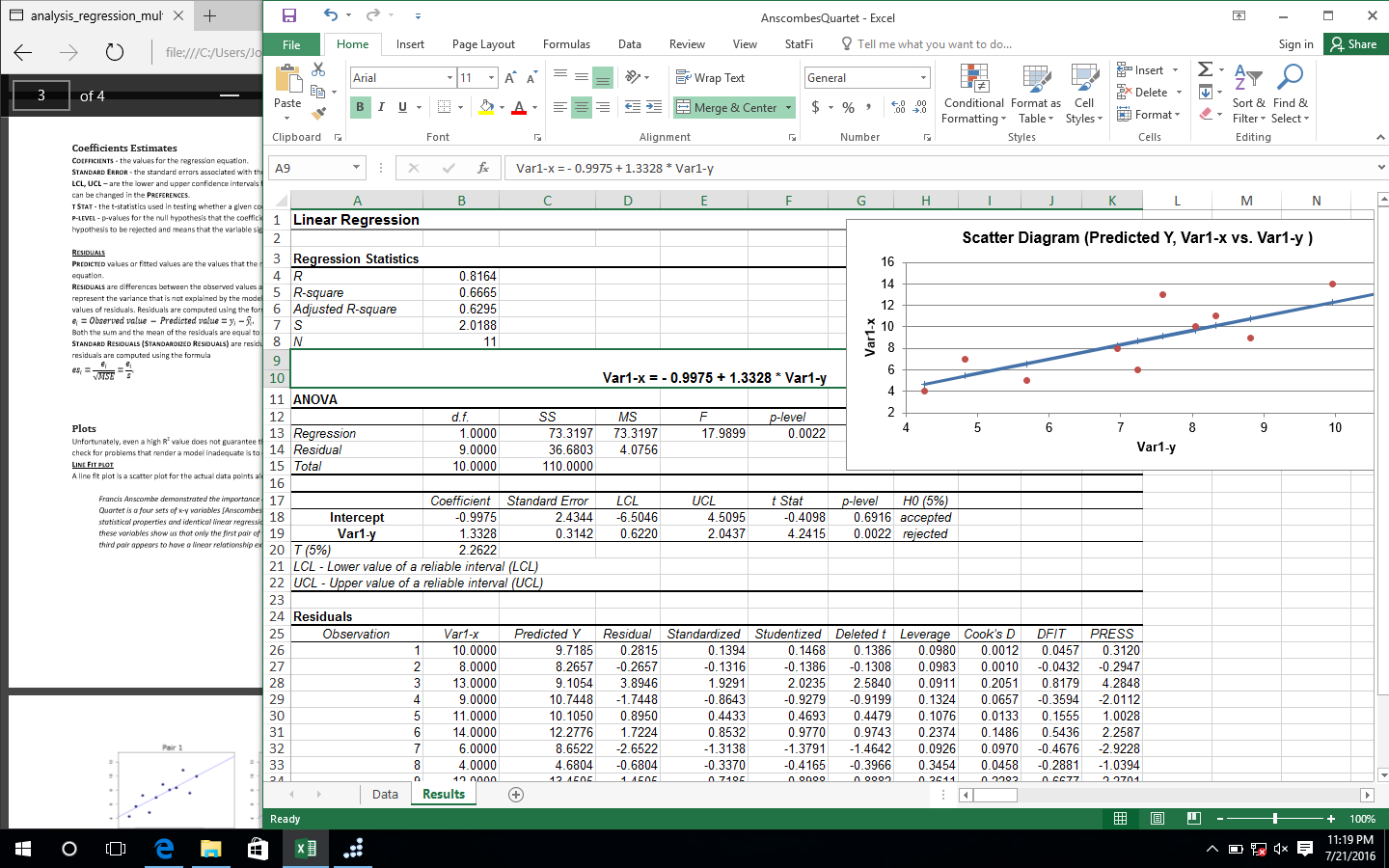
Introduction to Regression - Regression, perhaps the most widely used statistical
technique, estimates linear relationships between independent (explanatory)
variables and a dependent (outcome) variable. Regression models can be
used to help understand and explain relationships among variables; they can
also be used to predict actual outcomes. In this course you will learn how
regression models are derived, use software to implement them, learn what
assumptions underlie the standard regression model, learn how to test
whether your data meet those standard assumptions, and learn what can be
done when those assumptions are not met.
Sample Size and Power Determination - This course shows you how to make power and sample size determination for
experiments, surveys and long-term trials.
Spatial Statistical Analysis in Geographic Information Systems (GIS) - Spatial statistical analysis uses methods adapted from conventional statistics to address problems in which spatial location is the most important explanatory variable. This course will explain and give examples of the analysis that can be conducted in a geographic information system such as ArcGIS™ or Mapinfo™.
Statistical Process Control (With Applications in the Health Services) - This course will explain the theory and practice of using control charts to
monitor and control processes with an emphasis on application in the health service area.
Introduction to Statistics I: Inference for a Single Variable -
The aim of this course is to provide an easy introduction to statistics and statistical terminology through a series of practical applications. Once you've completed this course you'll be able to test hypotheses regarding proportions and means. You'll use simulation and resampling to fully grasp the difficult concept of "statistical significance."
Introduction to Statistics II: Working with Bivariate Data -
The aim of this course is to provide an easy introduction to inference for two variables through a series of practical applications. Once you've completed this course you'll be able to test hypotheses regarding a simple regression or a comparison of proportions or two means.
Structural Equation Modeling -
This course covers the fundamental concepts and theory of Structural Equation Modeling -- describing the relationships between variables. Case studies are used and AMOS software is introduced.
Advanced Structural Equation Modeling -
This course covers many popular advanced SEM models with practical exercises. Models covered include Multiple Indicator an Multiple Causes models (MIMIC), Multiple Group models, Multilevel (HLM) models, Mixture models, Structured Means models, Multitrait-Multimethod models, Second Order Factor models, Interaction models, and Dynamic Factor models.
Survey Design and Sampling Procedures -
This course covers the crafting of survey questions, the design of surveys, and different sampling procedures that are used in practice. Longstanding basic principles of survey design are covered, and the impact of the trend toward increased respondent resistance is discussed.
Survey Analysis -
This course covers the analysis of data gathered in surveys.
Survival Analysis -
The course describes the various methods used for modeling and evaluating survival data, or time-to event data.
Introduction to S-PLUS -
This course should get you started using the S-PLUS statistical package and understanding how to write S-PLUS script programs. Topics include basic statistical analysis, trellis graphing, hypothesis testing, Monte Carlo simulation, cross-validation, bootstrap, jackknife, and meta-analysis.
Text Mining - This course will introduce the essential techniques of text mining, understood here as the extension of data mining’s standard predictive methods to unstructured text.
Time Series Forcasting - This course will teach you how to choose an appropriate time series model, fit the model, to conduct diagnostics, and use the model for forecasting. The course will focus on Autoregressive (AR), Moving Average (MA), combined ARMA, and Box Jenkins type models.
Toxicological Risk Assessment - This course will cover the statistical procedures used in analyzing the risk from toxic substances, primarily the results of experiments. It covers significance tests for trends and their application to dose response relationships, modeling techniques for dose response relationships, benchmark dose estimation, and the incorporation of historical control information in dose response modeling.